Marketing funnel in Nepal Every channel, working as one journey to the sale
Ads, SEO, social media and your website, connected so each one passes customers to the next, and you can see what every rupee brought back.
Every lead is saved with the channel that brought it.
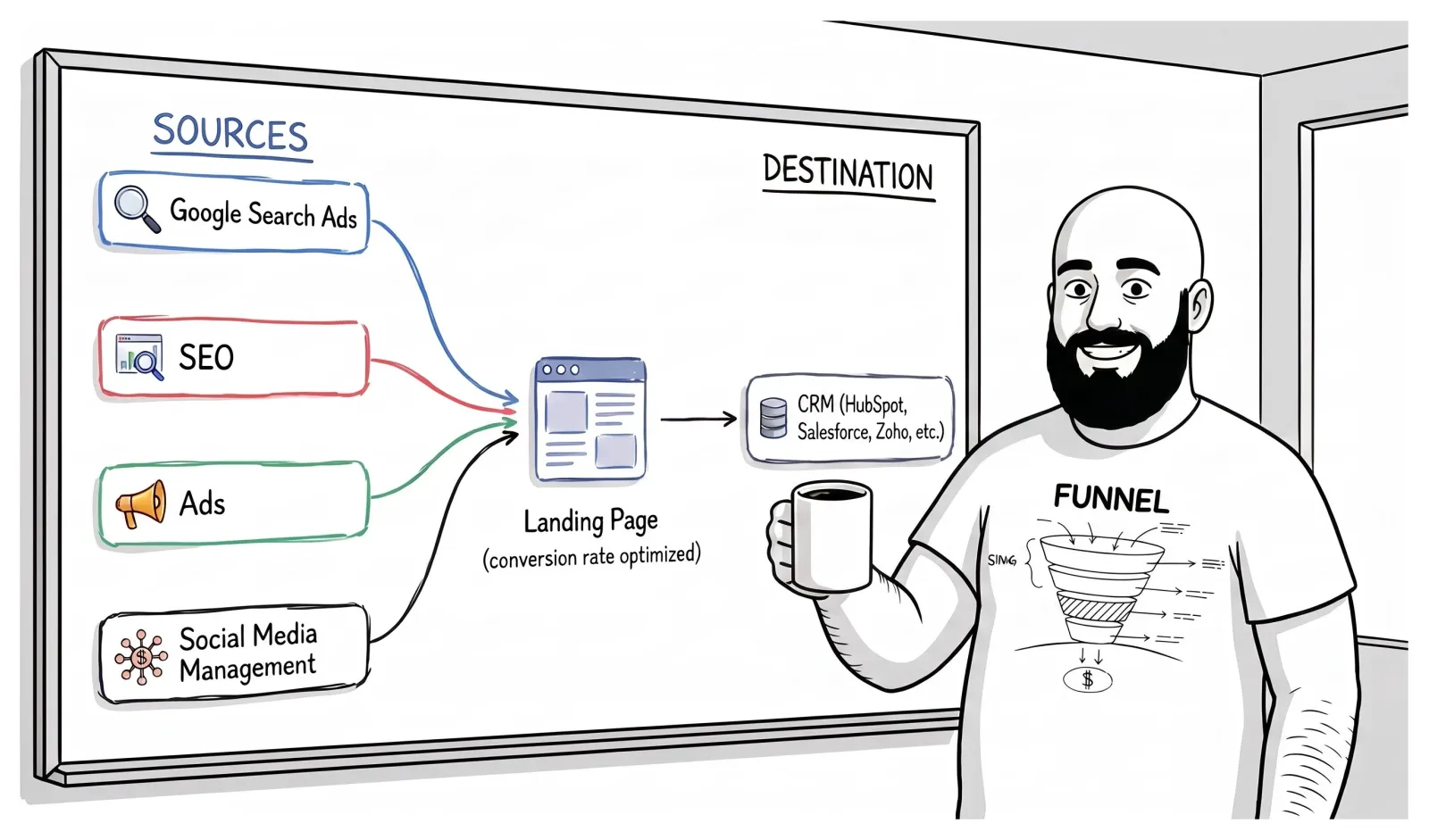
Customers don’t buy in channels. They buy in a journey.
Most businesses treat marketing like a collection of disconnected activities: an ad here, a social post there, a website somewhere else. But customers don’t move through your business in isolated channels. We design the entire journey around how your customers actually make decisions, from discovering you, to trusting you, to becoming ready to buy.
Discover → Trust → Buy
Every channel has a job in one of these three steps.
- 01
Discover
They find you: a Google search, an ad in their feed, a post a friend shared. Ads, SEO and social media do this job.
- 02
Trust
They check you before they decide: your page, your reviews, your posts, and how fast you reply. Your landing page and social media do this job.
- 03
Buy
They call, message or fill in a form, and someone follows up until they’re ready. Your CRM and follow-up do this job.
When each channel is run on its own, nobody owns the gaps between them. That’s where customers slip away. A funnel connects every step and measures it end to end, so you can see the gap and close it.
See how we connect themEvery part of the funnel, and what it does for you.
This is the whole funnel: people arrive from every channel, land on one page built to convert, and every lead is saved with where it came from. Below are its four parts: what each one does, and what you get. They work at the same time, not one after another.
 Google Search Ads
 SEO
SEO Ads
Ads Social Media Management
Bring the right people
Ads bring people now. SEO and social media bring them month after month. All four send people to the same landing page, so nothing is wasted.
What you get: more of the right people, from more than one place, at a cost you can see.
Google Ads
Shows your ad to people searching for what you sell, right now. Here, targeting is the words they search: we pick the searches that mean “ready to buy” and block the ones that don’t.
Google Ads in NepalFacebook and Instagram ads
Puts your offer in front of people before they start searching. Here, targeting is place, age and interests, and more and more the ad itself, so we test several genuinely different ads and keep the one that brings customers.
Facebook ads in NepalSEO
Gets your pages up Google for the searches your buyers make. It’s slower than ads, but you don’t pay for each click, and it keeps working.
SEO services in NepalSocial media
Your page is where people check you before they trust you. Posts that answer their questions and show real results, and replies that come fast.
Social media marketing
Turn visits into enquiries
Every ad and post sends people to one landing page made to turn visits into enquiries, not to your home page. One page, one offer, one action.
What you get: more enquiries from the same ad spend.
It converts because
- It matches what they searched or tapped, so they know they’re in the right place.
- It shows proof: reviews, results, real photos.
- It has one clear action: call, WhatsApp or a short form.
- It loads fast on a phone.
- It asks only for what you need to call back.
Turn enquiries into customers
An enquiry isn’t a sale yet. These three make sure nobody is forgotten, and the people who left without enquiring get a second chance.
What you get: more of your enquiries become customers.
CRM
Every lead in one place: name, number, where they came from, who’s following up and what happened. It starts as a shared Google Sheet with an instant alert on your phone; HubSpot or Zoho when you outgrow it.
Follow-up
A reply within minutes, saved answers to the common questions, a clear next step in every reply, and reminders to call back until they decide.
Retargeting
Most visitors leave without enquiring. Retargeting shows your ad again to people who visited your page or messaged you, with a reason to come back.
How we run ads
Know what works
Set up before launch, so every enquiry is counted from day one and every part above can be judged by what it brings.
What you get: every lead tied to its source, and budget that goes where customers come from.
- Example view, drawn to match the real report. The numbers are made up.
Tracking
The Meta Pixel and Conversions API, Google Analytics 4, and tracking on your call, WhatsApp and form buttons.
- Example view, drawn to match the real report. The numbers are made up.
Analytics
One view of every channel: where visitors came from, and which channel turns them into enquiries, not just traffic.
How it starts: in weeks 1–4 we map your customers’ journey and connect these parts. Then we launch on small budgets, and every month we fix the weakest part. Not sure which part is weakest now? We check it in the free audit.
Find my weakest partOne report for the whole funnel.
Separate agencies send separate reports. One funnel means one report: every channel side by side, then a page for each part that needs a closer look. The numbers are an example: a made-up clinic in Lalitpur.
Which channel brings customers, and what does each one cost?
| Where they came from | Ad spend | Enquiries | Customers | Cost per customer |
|---|---|---|---|---|
| Google Ads | Rs 25,000 | 40 | 7 | Rs 3,571 |
| Facebook and Instagram ads | Rs 30,000 | 60 | 5 | Rs 6,000 |
| Retargeting | Rs 5,000 | 10 | 2 | Rs 2,500 |
| SEO | None | 6 | 1 | No ad cost |
| Social media posts | None | 4 | 0 | No ad cost |
| Whole funnel | Rs 60,000 | 120 | 15 | Rs 4,000 |
Weakest stepFacebook brought the most enquiries, but only 1 in 12 became a customer. From Google Ads, about 1 in 6 did.
Next monthWe call Facebook enquiries back faster and test a clearer offer in those ads. Rs 5,000 moves to Google Ads and retargeting.
- 1Spend, enquiries and customers for every channel
- 2What one customer cost from each channel
- 3The weakest step, and what changes next month
We move budget toward the channels that bring customers for less, and fix the weakest step first, because one leaking step costs you customers from every channel.
Are we showing up for the searches that buy?
- 1The exact searches that showed your site, and how many people clicked
- 2How often you appear and get clicked, week by week
- 3Your average position for every search, and whether it’s climbing
We find searches where you sit just off page one and push those pages up, rewrite titles that get seen but not clicked, and fix pages Google can’t index.
Search Console keeps 16 months of data, so you can compare this year with last. Google Search Central
Where do visitors click, how far do they read, and where do they give up?
- 1A heatmap of every click and tap on the page
- 2How far down the page people really scroll
- 3Frustration signals: rage clicks, dead clicks and quick backs
We set this next to the page’s conversion rate (enquiries ÷ visitors, from Analytics). Then we move the main button to where people already look and tap, cut what nobody reaches, and fix what people try to tap in vain. One change at a time, so we know what worked.
Clarity is free with no traffic limits, and masks sensitive content by default. Text typed into forms is never recorded. Microsoft Learn
Are local buyers finding you on Maps, and calling?
- 1Calls, direction requests and website clicks from your profile
- 2The searches that showed your profile on Maps and in Search
- 3Calls month by month, so you can see the trend
We keep your profile complete, add photos and services, ask happy customers for reviews and reply to every one.
Google says local results are mainly based on relevance, distance and popularity, and that more reviews and positive ratings can help your local ranking. Business Profile Help
The whole funnelPage 1 of 4
Every month: what each channel brought, the weakest step, and what we change next.
This is the point of one funnel: you can only compare channels when they’re measured the same way, and that comparison tells you where the next rupee should go.
Same channels. Connected, they bring customers.
Disconnected activities
- An ad here, a post there, a website somewhere else
- Each channel reported on its own: likes, reach, clicks
- Clicks sent to the home page
- Enquiries left in inboxes, then forgotten
- Nobody knows which rupee brought a customer
One customer journey
- One plan from the first ad to the sale
- Every channel sends people to one landing page, optimised to convert
- Every lead saved with where it came from
- Follow-up until they’re ready to buy
- One report: what a customer cost, by channel
Let’s map your customer journey.
Tell us about your business. Before we call, we trace how customers find you today and where they slip away, so the first call starts with your weakest step.
What a marketing funnel is, and who it’s for.
A marketing funnel is the path a customer takes from first hearing about you to paying you, and the marketing built around each step of it. Some agencies call this performance marketing, or lead generation: marketing judged by results you can count, such as enquiries, customers and cost per customer. Performance marketing in Nepal usually stops at the ads; a funnel also covers the page and the follow-up. For businesses in Kathmandu, Lalitpur, Bhaktapur, Pokhara and across Nepal, we build both: every channel connected, and every step measured.
Best for
- Businesses that already sell and want more of the right customers, usually doing Rs 36 lakh or more a year.
- Owners who want numbers, not reports full of reach and impressions.
- Teams who can reply fast, or who want help setting that up.
- Businesses that want to scale, and need every channel to bring more customers as the budget grows.
Not the right fit yet
- Brand-new ideas with no sales yet. Talk to customers first; ads can’t find demand that isn’t there.
- Fully booked businesses. Raise prices or add capacity before you pay for more enquiries.
Questions people ask before they start.
Straight answers, no sales talk.
What is a marketing funnel?
The path a customer takes from first hearing about you to paying you: they discover you, they decide to trust you, they buy. A marketing funnel is the marketing built around that path, with every channel connected and every step measured, so you can see where people drop off and fix it.
Is a marketing funnel the same as performance marketing?
Close. Performance marketing means judging marketing by results you can count: enquiries, customers and what each customer cost. A funnel is how you get those results: the channels, the landing page, the follow-up and the tracking, built as one journey. We do both.
Do I need every part of the funnel?
No. Most businesses already have some parts working. We find the weakest step first, often the landing page or the follow-up, fix it, and add channels after that.
How much does a marketing funnel cost in Nepal?
There are two parts. The ad budget goes to Meta or Google, and you decide it. The work (the landing page, the tracking, the ads and the follow-up, then improving them every month) is our fee. It depends on how many channels and how much setup you need, so we give you an exact number in rupees after the free audit. We don’t sell fixed packages.
How soon will I get enquiries?
Ads can bring the first enquiries within days of launch. The first few weeks are for testing: different ads, audiences and offers. After that, the goal is to bring the cost per customer down month by month. SEO adds enquiries more slowly, over months.
Do you work on a pay-per-lead basis?
We agree the model with you on the call. Pay-per-lead sounds safe, but it rewards whoever delivers the most leads, not the best ones. Most businesses do better paying for the work and judging it by cost per customer, which is the number we report every month.
What do I need to provide?
Access to your Facebook page, ad account and website (or we build the page), someone who can answer enquiries fast, and honest numbers: what a customer is worth to you and how many you can handle. We do the rest.
Which businesses does this work for?
Any business where one customer is worth more than it costs to get them, and where people search or scroll before they buy: clinics, consultancies, schools and institutes, real estate, travel, home services and online stores. It works best once you already sell and want more of the right customers.