Facebook ads agency in Nepal Ads that pay for themselves
We fix your offer first, then run Facebook and Instagram ads built to bring customers for under 30% of what they pay you. Paid in rupees, no dollar card.
Your ad account stays in your name. You see every rupee, live.
Paid ads are worth it only when they make you money.
You know what you spent on ads last month. But do you know what one customer cost you? That one number decides whether your ads bring you profitable customers or just cost money, so it’s the number we plan every campaign around.
CAC<30% of AOV
Customer acquisition cost under 30% of average order value
- 01
What it means
Winning a customer through ads should cost less than 30% of what that customer pays you. A customer pays you Rs 10,000? We aim to win them with less than Rs 3,000 of ads.
- 02
Why 30%
The customer’s first payment covers the ads, and what’s left pays for delivering your service and your profit. When they buy again, you don’t pay to win them a second time.
- 03
To be honest
30% is our average target, not a promise. Thin margins need a lower line; customers who buy again and again can carry a higher one. Your industry and competitors matter too. We work out yours from your real numbers in the free audit.
The four numbers behind it
- AOVAverage order valueWhat a customer pays you per order.
- CACCustomer acquisition costWhat the ads spent to win one customer: ad spend ÷ new customers.
- LTVLifetime valueThe profit one customer brings over all their orders, after the cost of delivering.
- PaybackPayback periodHow long until a customer has paid back what they cost to win. If your margin is above 30% and CAC stays under 30% of the first order, the first sale pays it back.
We work on all four, so that CAC stays under 30% of AOV.
Silicon Valley uses a similar test: lifetime value should be at least 3× the cost of winning the customer. Investors treat it as a rough check of a healthy business, a pattern rather than a rule.
We use both. 30% of the order tells us quickly whether one ad works. 3 to 1 over a customer’s lifetime tells us whether the whole account does.
Andreessen Horowitz, “Why do investors care so much about LTV:CAC?”
How paid ads actually work: three audiences, one system.
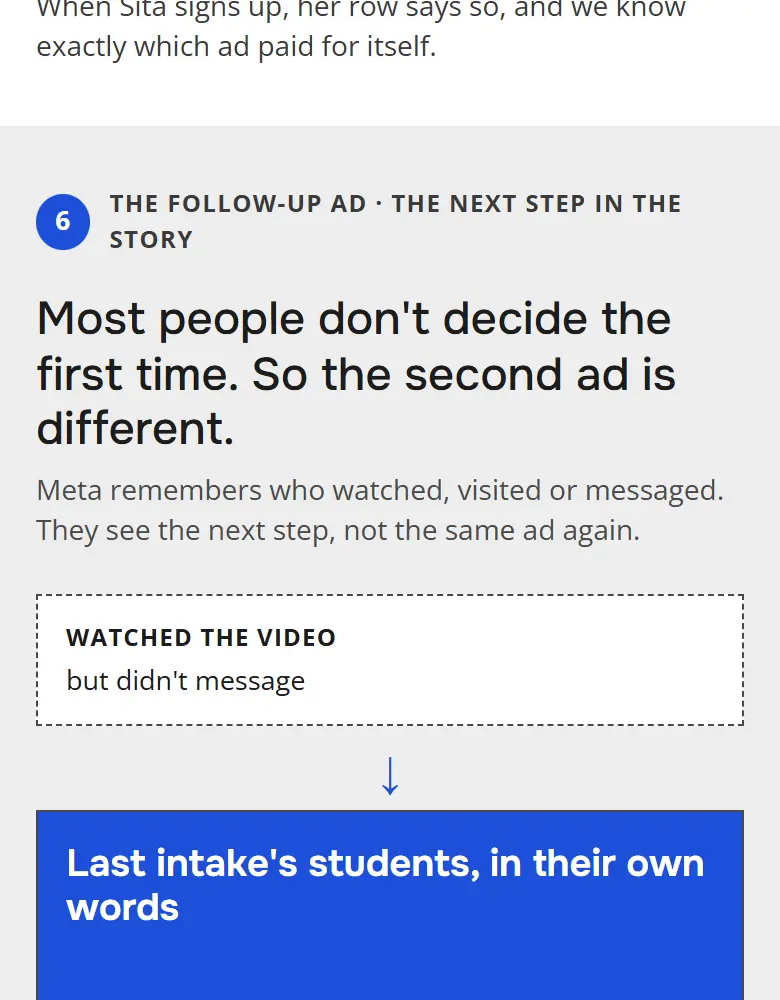
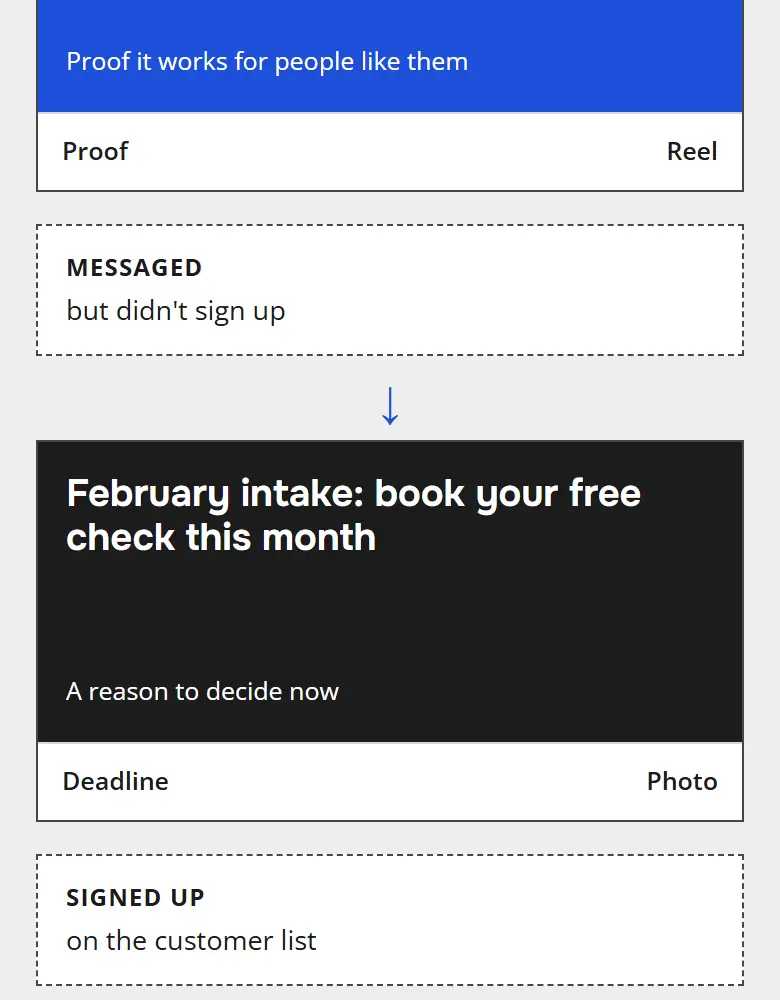
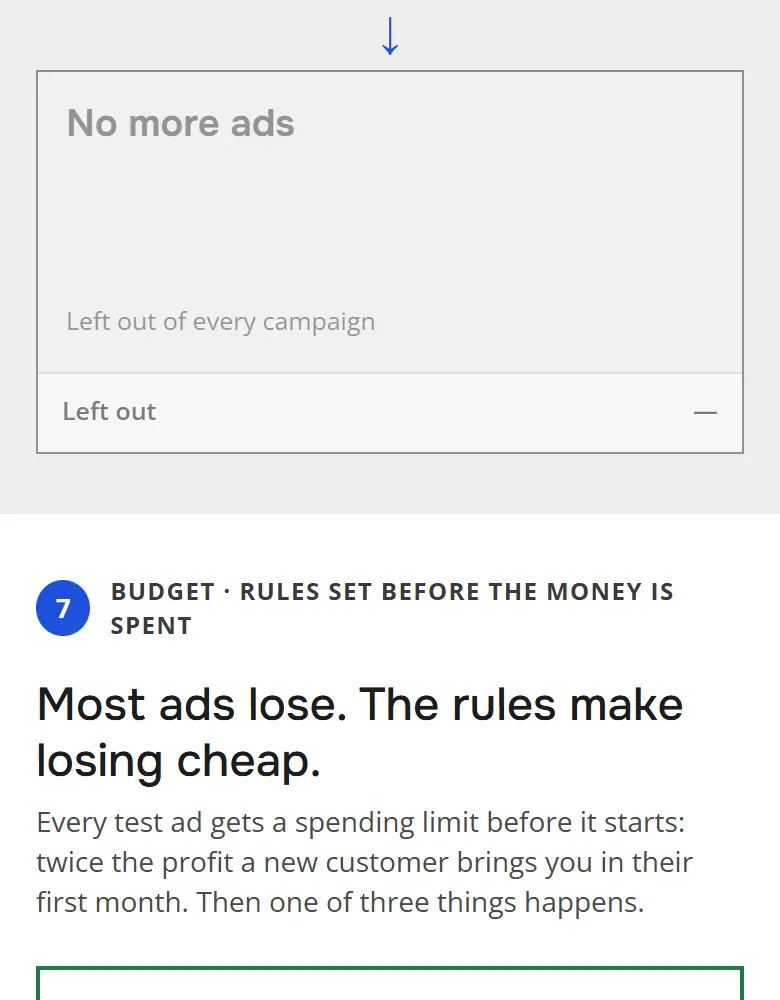
A boosted post shows one ad to strangers. A real campaign follows people from “never heard of you” to “paid you”, with a different ad at each step.
- Strangers
People who’ve never heard of you
They seeAn ad that makes the right people stop scrolling
- Interested
They watched, visited or messaged
They seeProof that it works for people like them
- Ready to buy
They asked, but didn’t buy yet
They seeA reason to decide now
- Customer
They paid you
ThenNo more ads: you never pay to reach them again
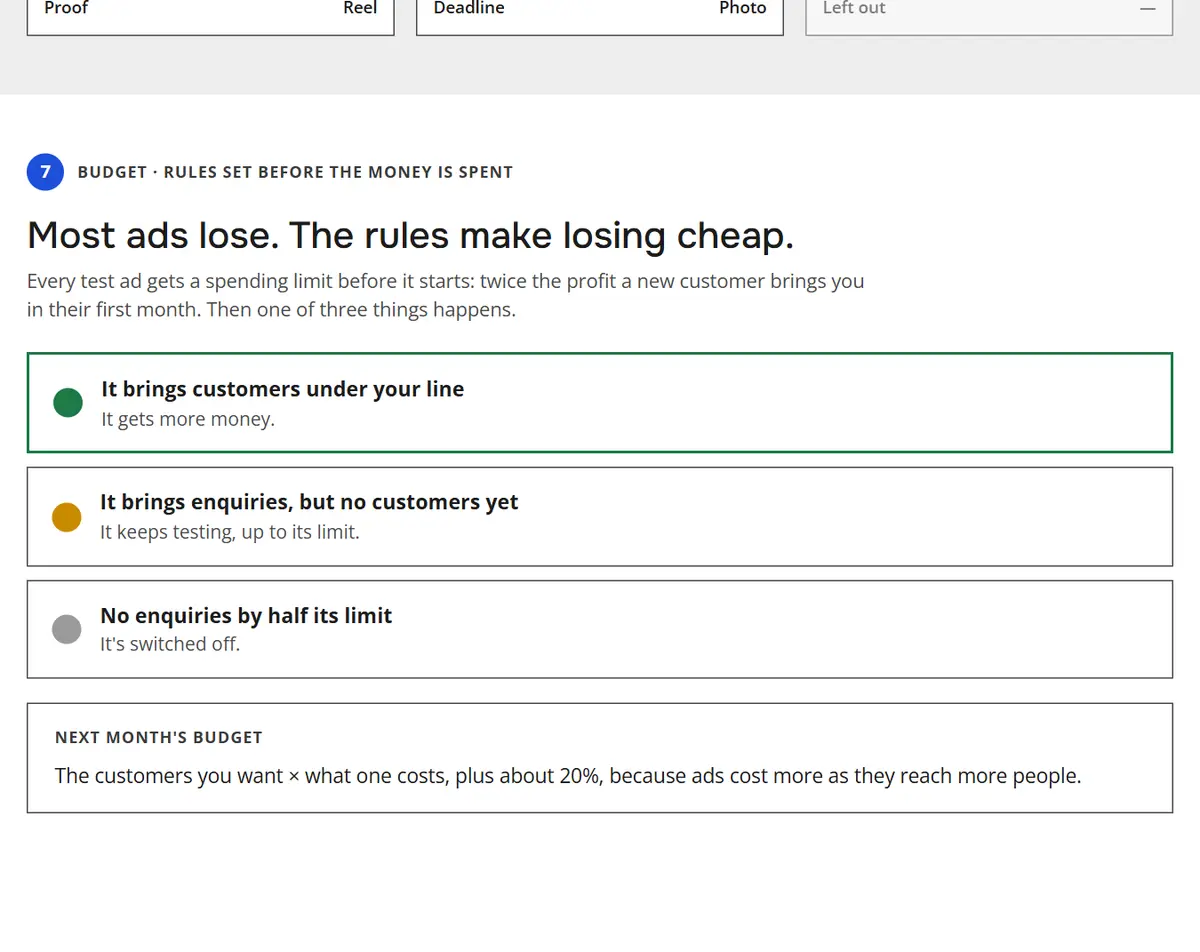
- People who don’t buy yet aren’t lost. Meta remembers who watched your videos (for up to a year) and who visited your website (for up to 180 days), so they see the next ad in the story, not the same one again.
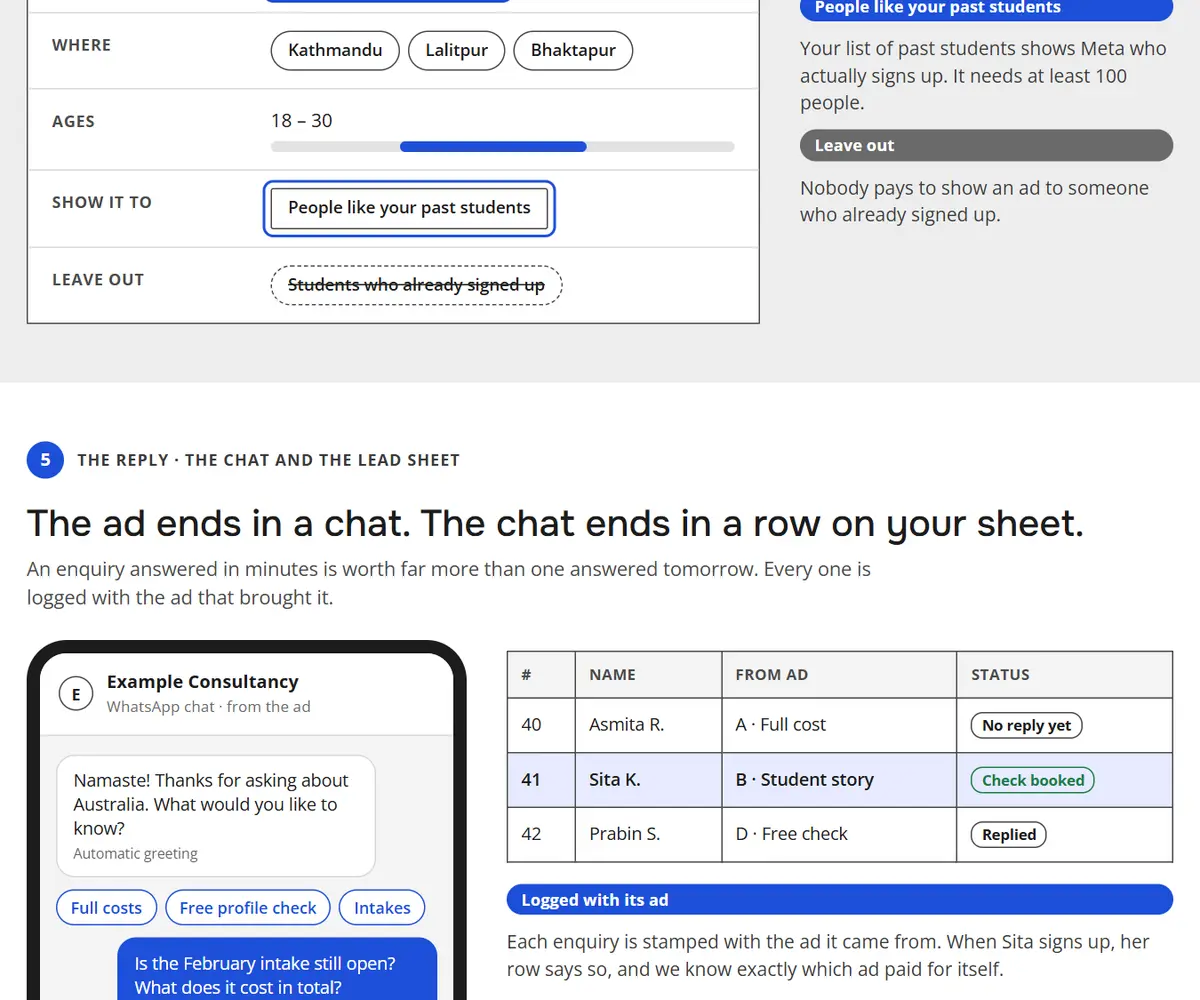
- We ask Meta for enquiries and sales, never likes. Meta finds the kind of people you ask for. Ask for likes and you get people who like things.
Meta for Developers: website audiences · Meta Business Help: choosing an advertising objective
Reach is cheap. The offer and the ad decide the profit.
Anyone can buy reach on Facebook in Nepal. What separates ads that make money from ads that don’t is the ad itself, and what happens after someone taps it.
- 14.8M
people in Nepal that Facebook ads can reach: 75.6% of adults. Reach is cheap and easy to buy.
DataReportal, Digital 2026: Nepal - 47%
of the sales that advertising produced came from the creative, more than reach or targeting, in Nielsen’s study of 500 campaigns.
Nielsen, 2017 - 10M+
ads that Meta’s system narrows to a few thousand for each person, partly by reading what’s in each ad. So the ad itself does much of the targeting.
Meta Engineering, Andromeda - 7×
as likely to qualify an online enquiry: companies that replied within an hour, against those that waited even an hour longer. A study of 1.25 million enquiries.
Harvard Business Review, 2011
Anyone can buy reach. What decides whether ads make money is the offer, the ad and how fast you reply, so that’s where we start.
Same budget. Built on your numbers, not on a post.
A typical boosted page
- Nobody knows what a customer costs
- “Call for price”: no reason to pick you
- Boost whichever post got likes, until it tires
- Messages answered hours later, never counted
- Judged by reach and likes
An EverestRise account
- Start from your numbers: what a customer is worth, and the most we can spend to win one
- An offer built on your business math, so people have a reason to choose you
- Many genuinely different ads; your buyers pick the winner
- Every enquiry answered fast and traced to the ad that brought it
- Judged by one number: a customer costs under 30% of what they pay
Before we spend a rupee on ads, we fix what the ad is selling.
A better offer makes every ad cheaper: more people stop, more click, more buy. We don’t hand you a template. We build your offer from your business math, so it gives the highest return your business can safely support.
- 01
Your business math
- What a customer pays you (AOV)
- What it costs you to deliver
- How often customers buy again (LTV)
- How many customers you can serve
- The most we can spend to win one (CAC)
What you getWe know the most we can spend to win a customer, and how much risk your business can safely take on.
- 02
The value equation
Value =Result they want × belief it will workTime it takes × effort it costs- The result your buyers want, in their words
- Proof it works for people like them
- A faster first result
- Less effort and hassle for the buyer
What you getPeople see more value at the same price, so you stop competing on price.
- 03
Make it hard to say no
- A guarantee that takes the risk off the buyer
- Urgency: a real reason to decide this week
- Scarcity: real limits on seats, slots or stock
- Bonuses that make the offer feel like a steal
- Fear of missing out: proof that others are already getting the result
What you getBuyers decide now instead of “someday”, and every promise is one your numbers can keep.
- 04
Give it a name
- A name only you have
- It says the result, not the service
- Easy to refresh when the ads tire
What you getYou can’t be compared line by line with the shop down the road.
The value equation and the guarantee, scarcity, urgency and bonus ideas are from the book $100M Offers.
Here’s exactly how that offer becomes ads that sell.
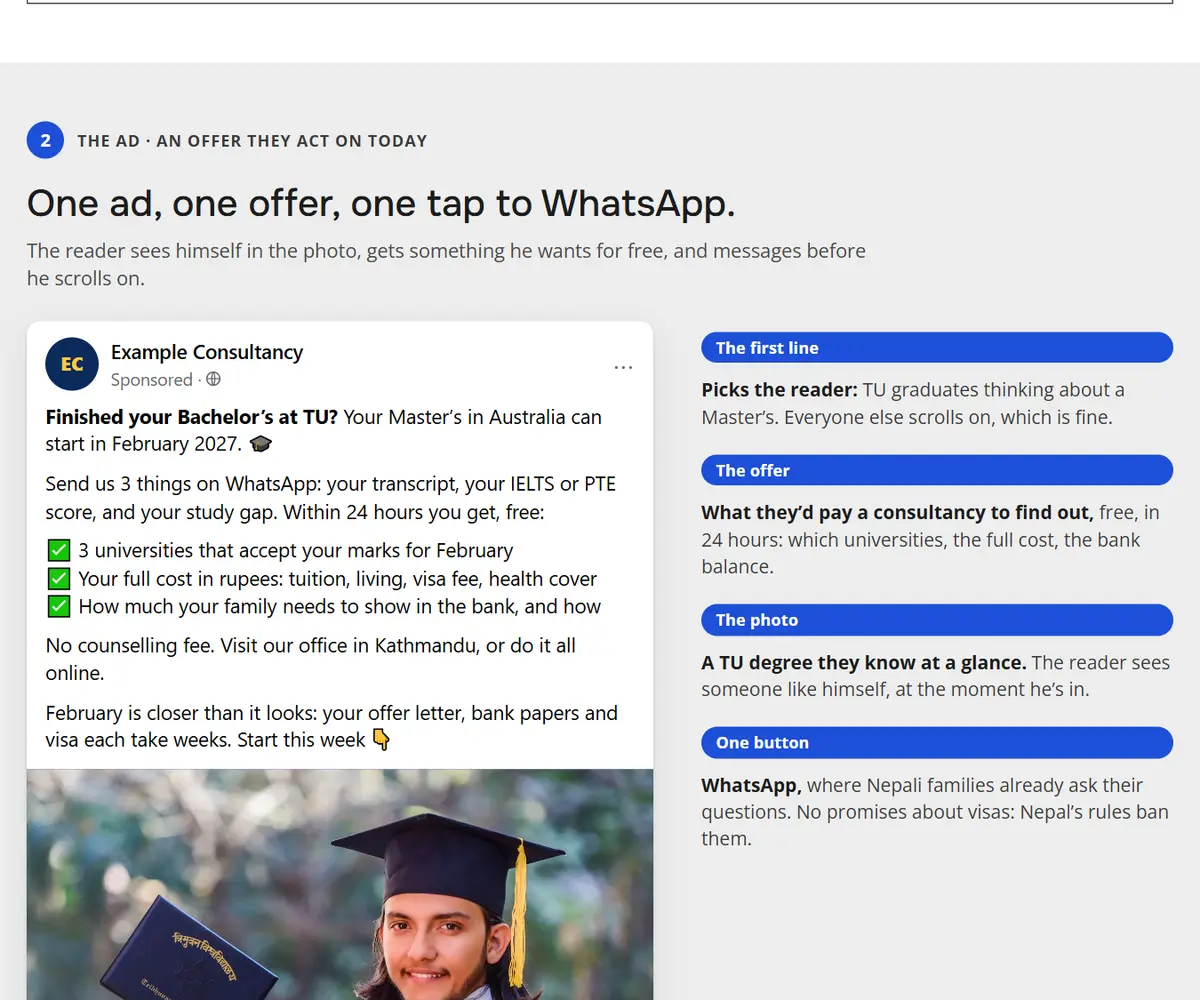
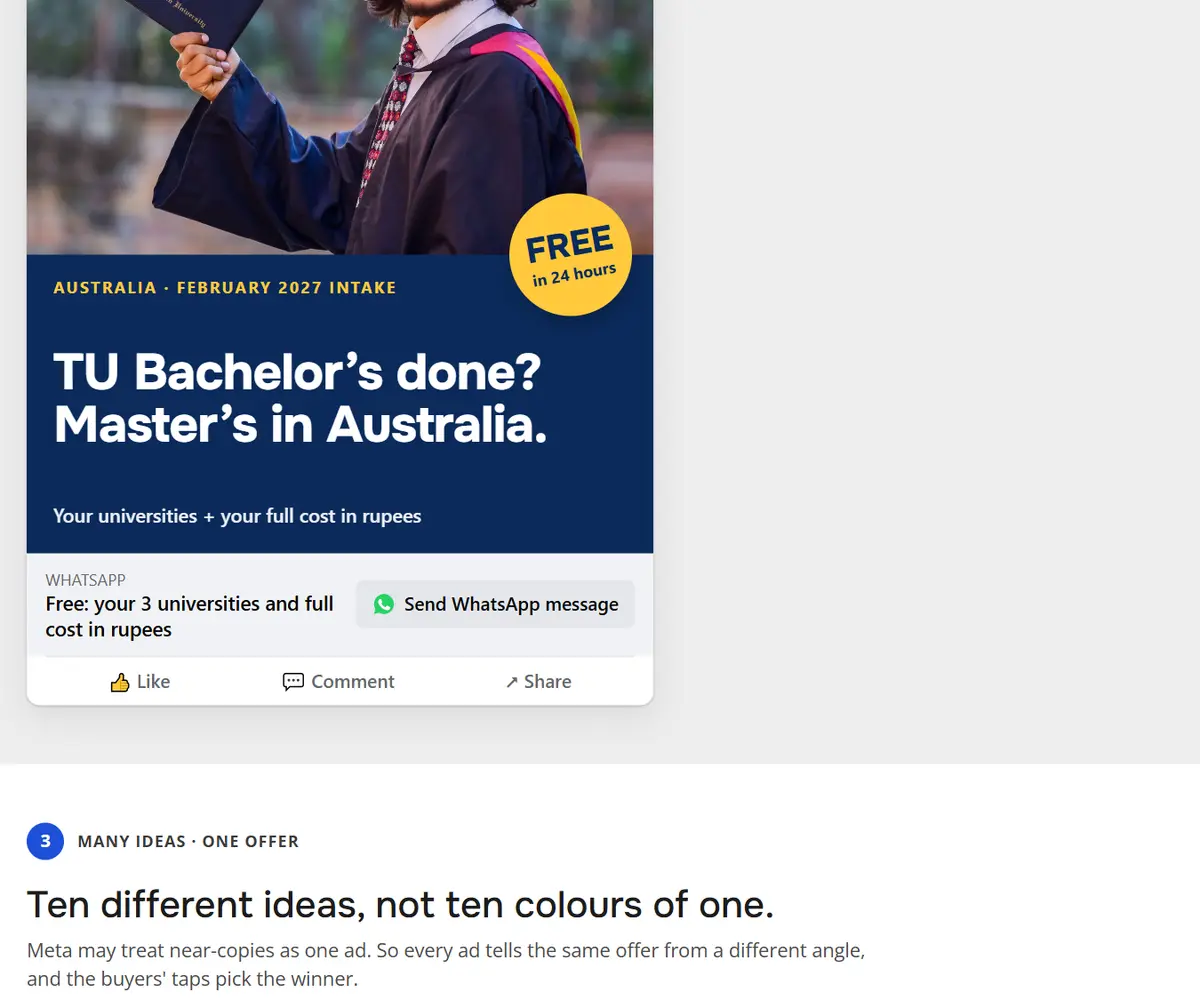
One example campaign in seven parts. Each part says what we do and what you get from it.
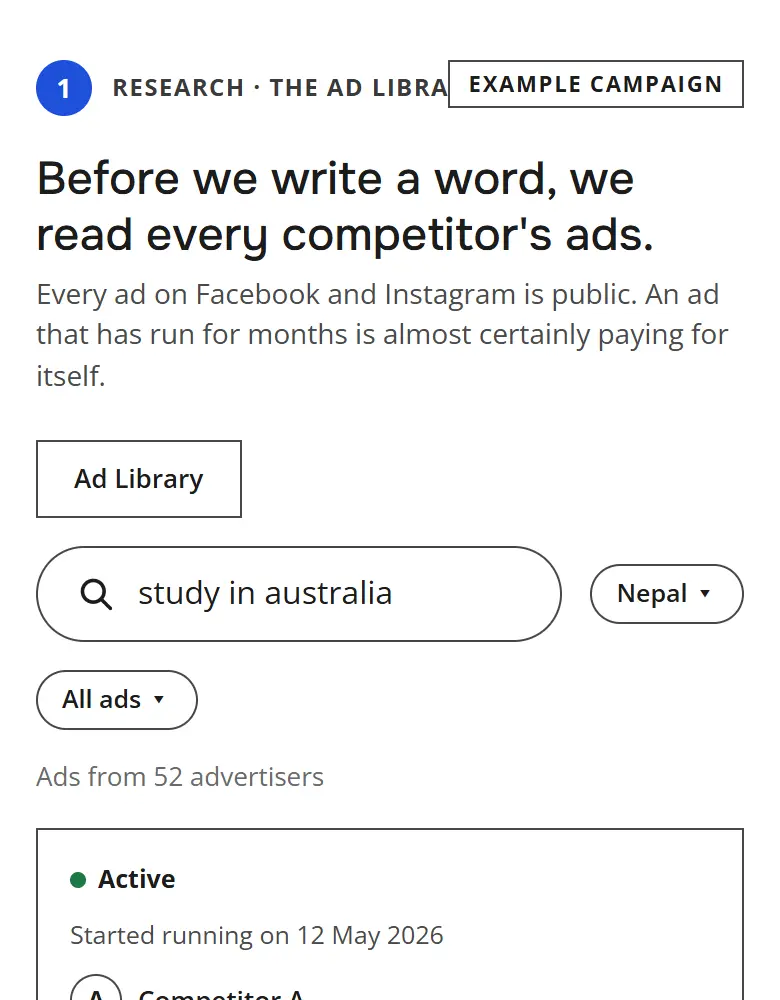
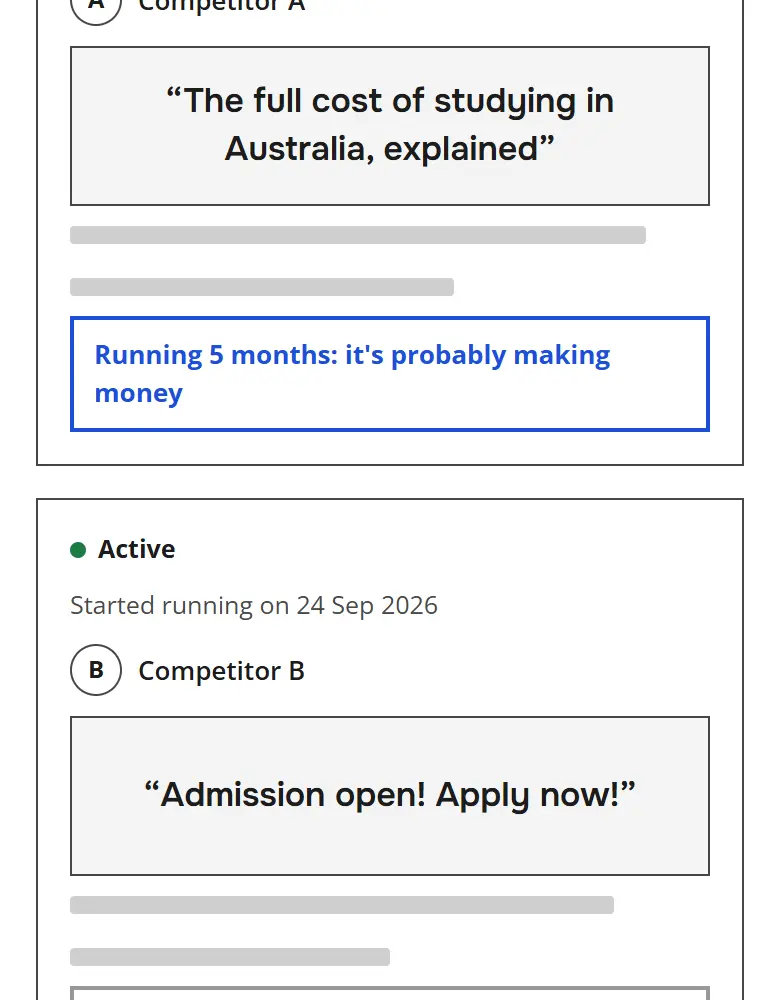
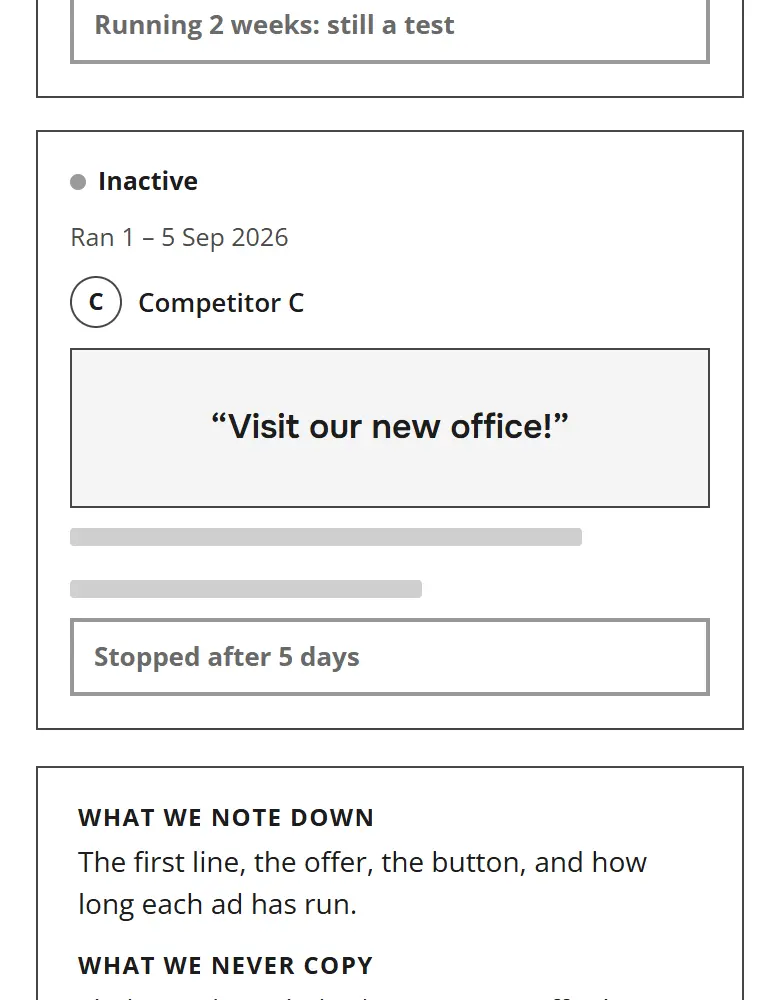
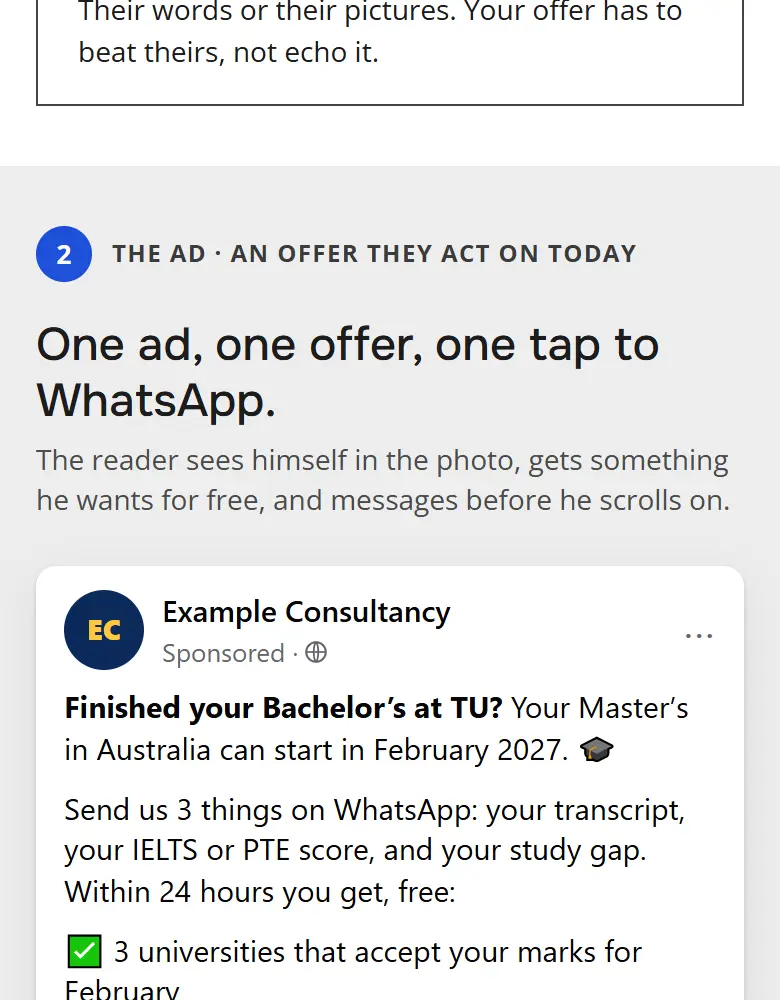
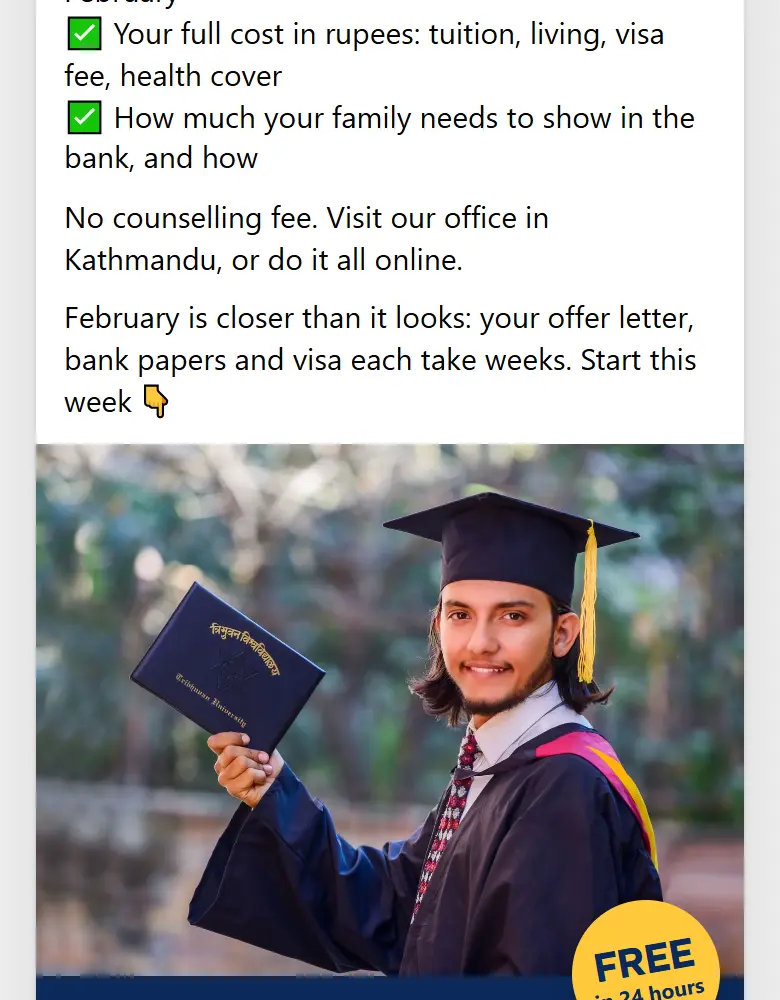
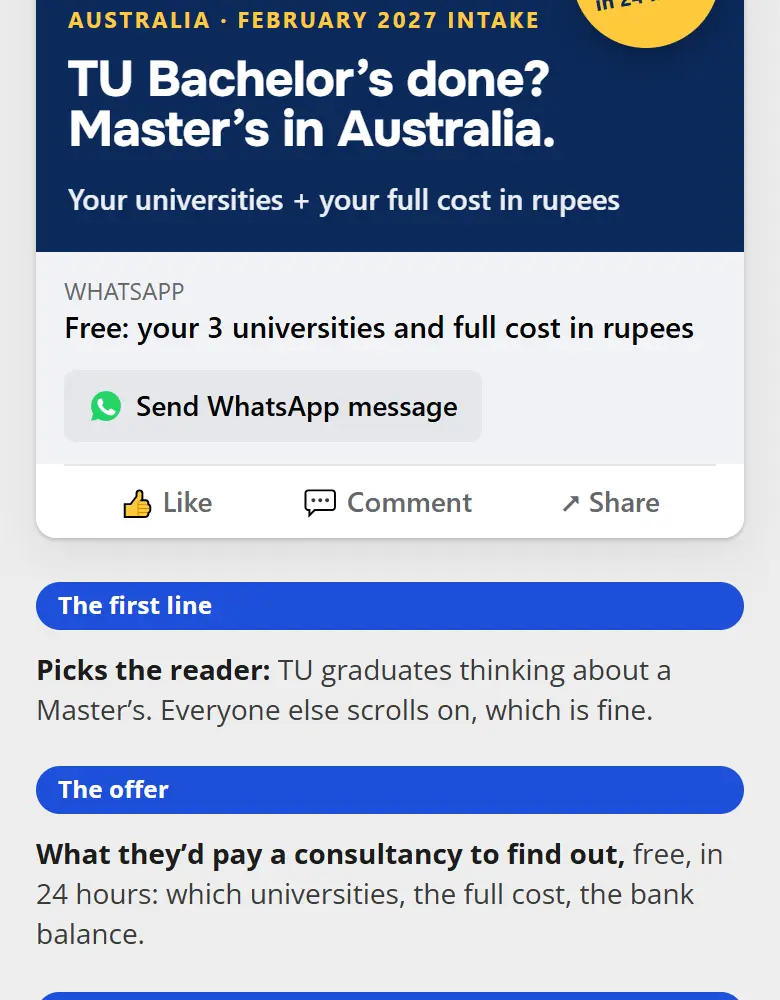
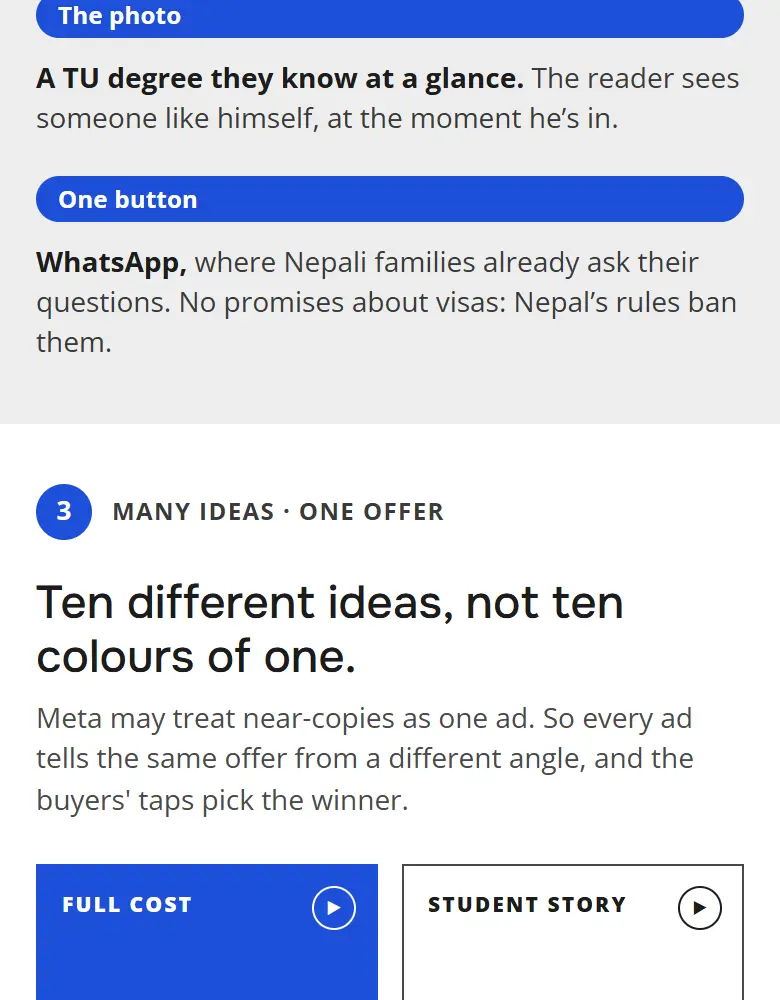
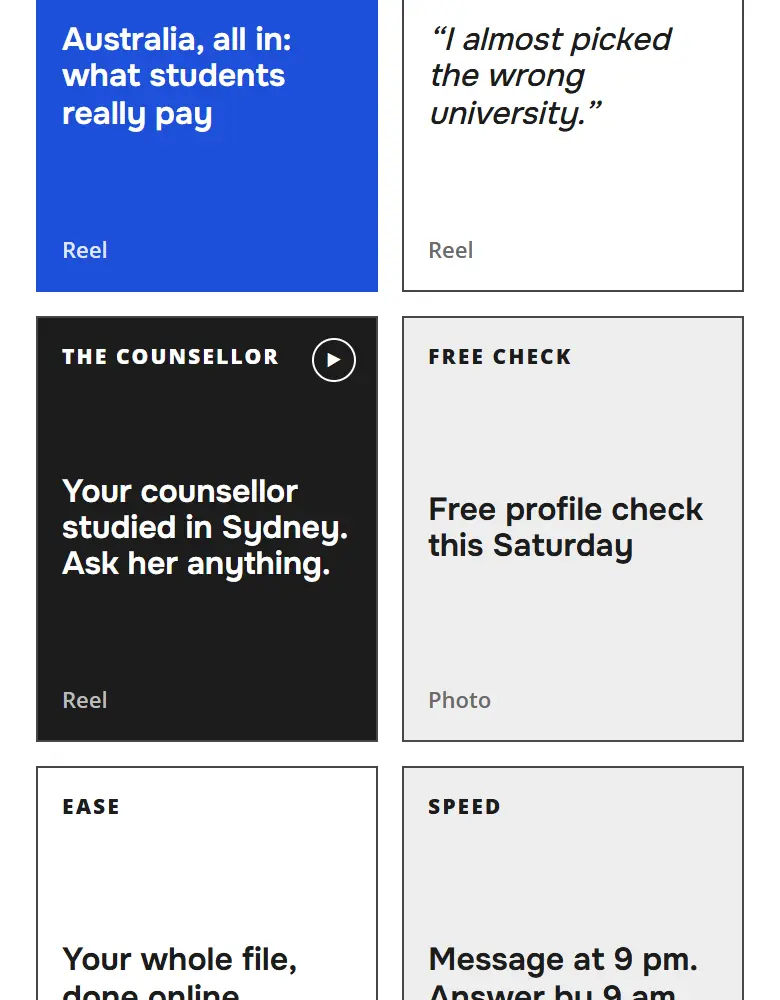
Track first. Then test. Then scale what sells.
Three phases: set up the tracking and the offer, test the ads on a fixed budget, then put more money behind the ones that bring customers. The spending limits are agreed with you before the first rupee.
Week 1: tracking before the first rupee
Setup
We get access to your ad account, Facebook page and Instagram, install the Meta Pixel and Conversions API, and connect your lead sheet. We build your offer from your numbers, then write and design the first ads. Nothing is spent until tracking works.
- Ad account, Pixel and Conversions API
- Your offer and the first ads
- Lead sheet connected
Test
Campaigns go live on a testing budget, with about 10 different ads. Each ad has a spending limit set in advance. Ads that bring no enquiries by half of it are switched off, and the ones that bring customers are kept.
- About 10 ads on a testing budget
- A spending limit for each ad
- Losing ads switched off
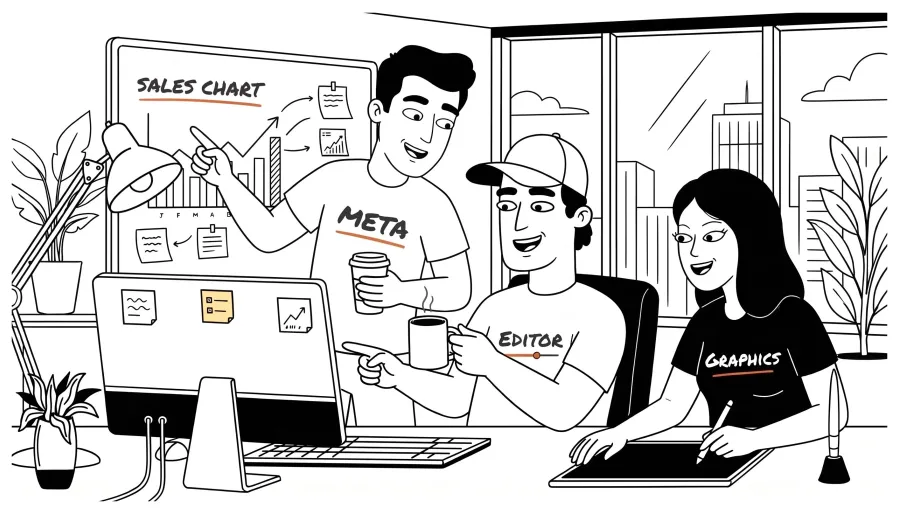
Scale
The budget goes up on the ads that bring customers, worked back from how many customers you want next month. New ads are tested against the winners every few weeks, retargeting brings back people who showed interest, and you get a report in rupees every month.
- Budget raised on the winners
- New ads and retargeting
- A monthly report in rupees
We follow every rupee from the ad to the sale.
Ads Manager only sees part of the story. Here’s how one enquiry is traced from the tap on the ad to the fee paid, and how that sale goes back to Meta so it finds more people like her. Turn the pages:
Sita taps the ad and lands on your page. Does Meta see what she does?
Viewed the pageLanded from ad BRead the costsScrolled to fees and intakesTapped WhatsAppBlocked by her browser…Tapped WhatsApp…sent again from your server, counted once
- 1A small code on your site, the Meta Pixel, tells Meta what each visitor does: read the page, tapped WhatsApp, sent the form.
- 2Some browsers and phone settings block that code. So your server sends the same actions again (Meta’s Conversions API), and Meta counts each one once.
Meta sees the real enquiries your ads bring, nothing counted twice, and never a page view passed off as a result.
Meta says the Conversions API connects your data to the systems that “optimize ad targeting, decrease cost per result and measure outcomes”. Meta for Developers
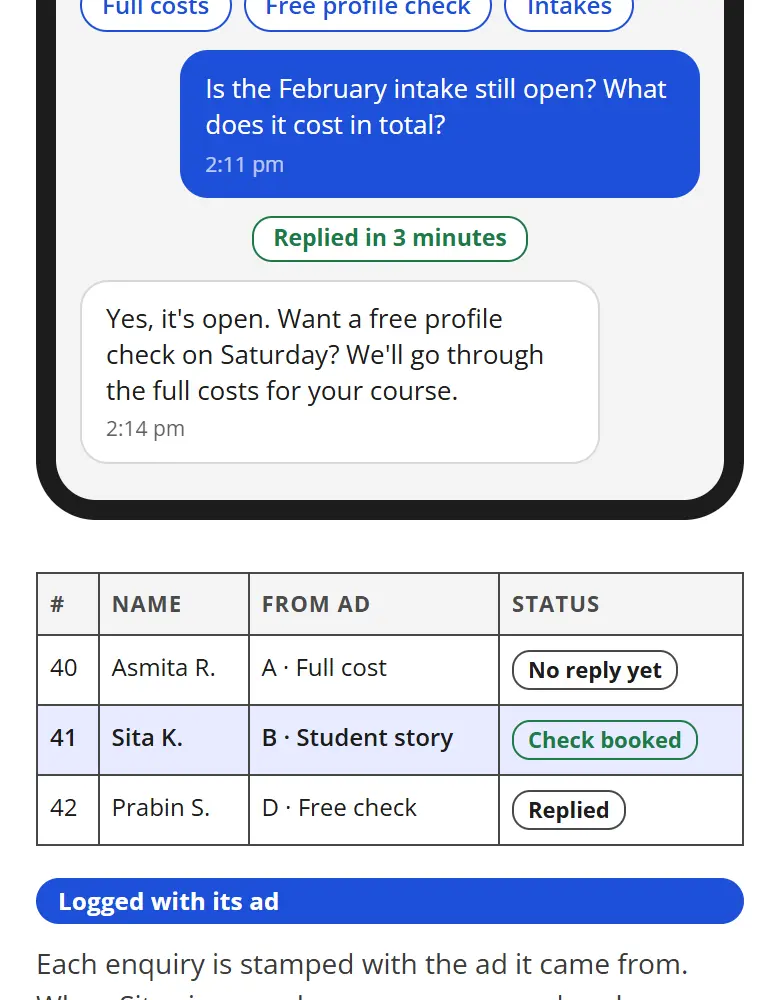
Most Nepali buyers don’t fill in forms. They message.
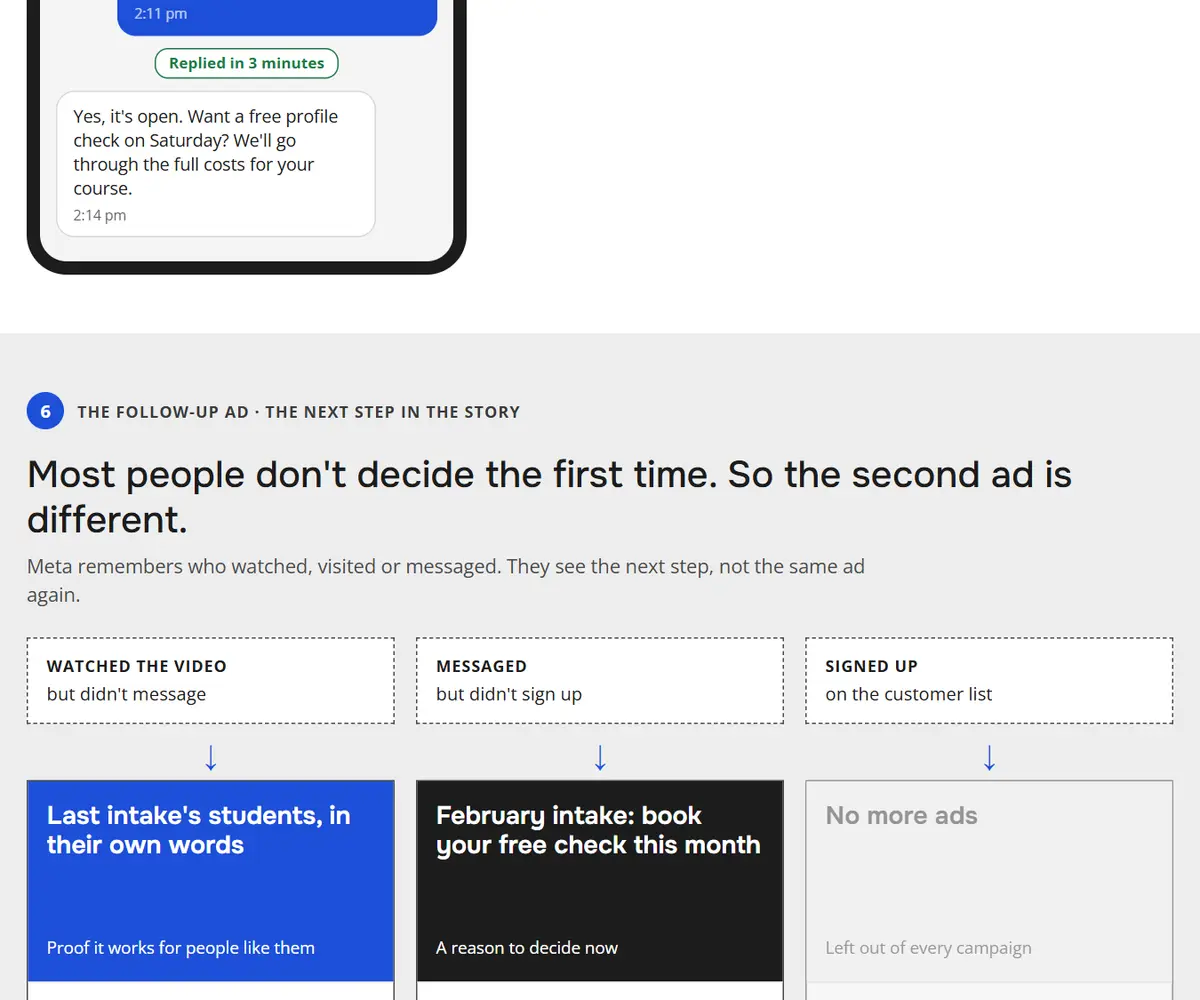
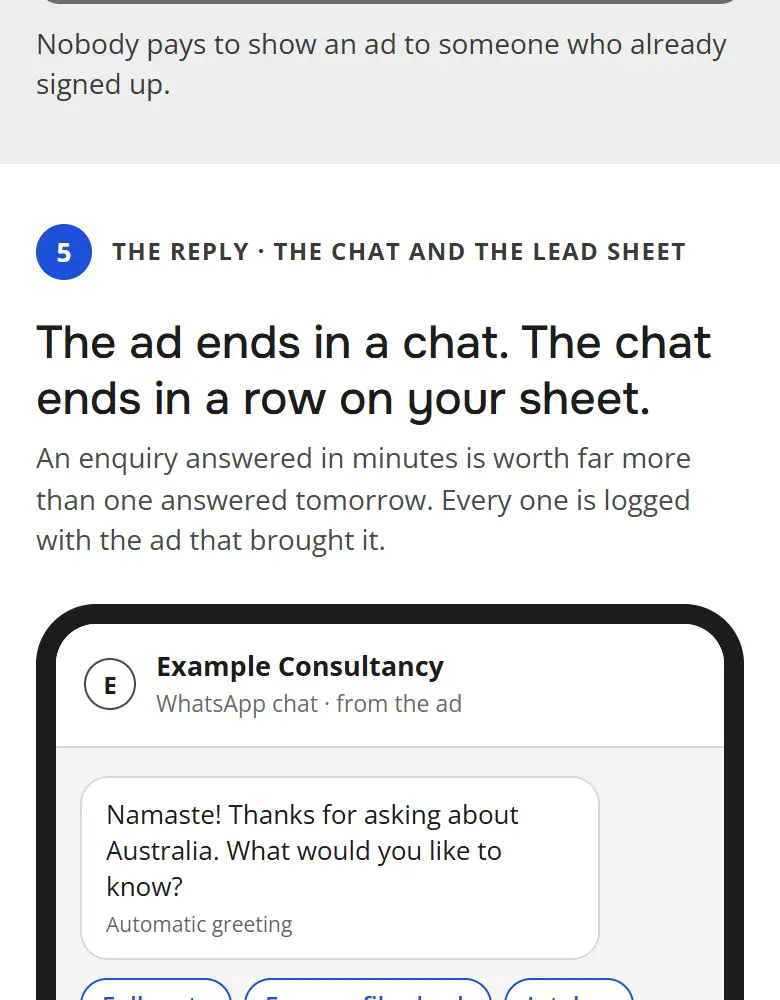
Is the February intake for Australia still open? What does it cost in total?
Yes, it’s open. Want a free profile check on Saturday? We’ll go through the full costs and which universities fit your scores.Replied in 3 min
- 1A tap on “Send WhatsApp message” is counted as a conversation, against the ad that brought it.
- 2Form enquiries arrive within minutes, with the answers people gave.
Every enquiry gets a fast reply from a real person, because that is where the sale starts. A slow reply wastes what the ad already spent.
Instant forms can be set to “Higher intent”: a review screen before sending means fewer, but more serious, enquiries. Meta Business Help: About instant form types
Did Sita sign up? Ads Manager will never know unless we tell it.
| # | Name | Ad | Status | Paid |
|---|---|---|---|---|
| 40 | Asmita R. | A · Full costs | No reply yet | — |
| 41 | Sita K. | B · Student story | Signed up | Rs 40,000 |
| 42 | Prabin S. | D · Profile check | Counselling booked | — |
- Replied
- Counselling booked
- Signed up
- Paid
- 1Every enquiry is a row, stamped with the ad it came from.
- 2Its status moves along: replied, counselling booked, signed up, paid.
The one place where “results” turn into customers and rupees. It’s your sheet, in your Google account, open to your whole team.
Teach Meta to find people who sign up, not people who chat.
- 1When a row says “Signed up · Rs 40,000”, that sale is sent back to Meta, matched to the ad Sita tapped.
- 2Meta can then learn what a real customer looks like and show your ads to more people like her.
Ads aimed at buyers. Without this, Meta keeps finding people who are happy to chat and never pay.
With instant forms, Meta can go one step further and aim for enquiries that become sales. It needs at least 200 enquiries a month, between 1% and 40% of them becoming customers, and the sale within 28 days. Meta for Developers
Which ad really paid for itself?
Ads Manager says the boosted post is the best: the cheapest result.The lead sheet says the opposite. The boosted post’s 300 messages became 1 customer, at Rs 15,000: over the 30% line of Rs 12,000. The student story wins, at Rs 4,125 a customer.
Example numbers. The customers column comes from your lead sheet, where each enquiry is marked with its ad.
By default, Meta gives an ad credit for a sale if the person clicked it in the last 7 days or saw it in the last day, even when something else made them decide. That’s one reason Ads Manager and your sheet never match exactly, so we report from the sheet. Meta Business Help: About attribution settings
Your website reports every enquiryStep 1 of 5
Let’s make your ads pay for themselves.
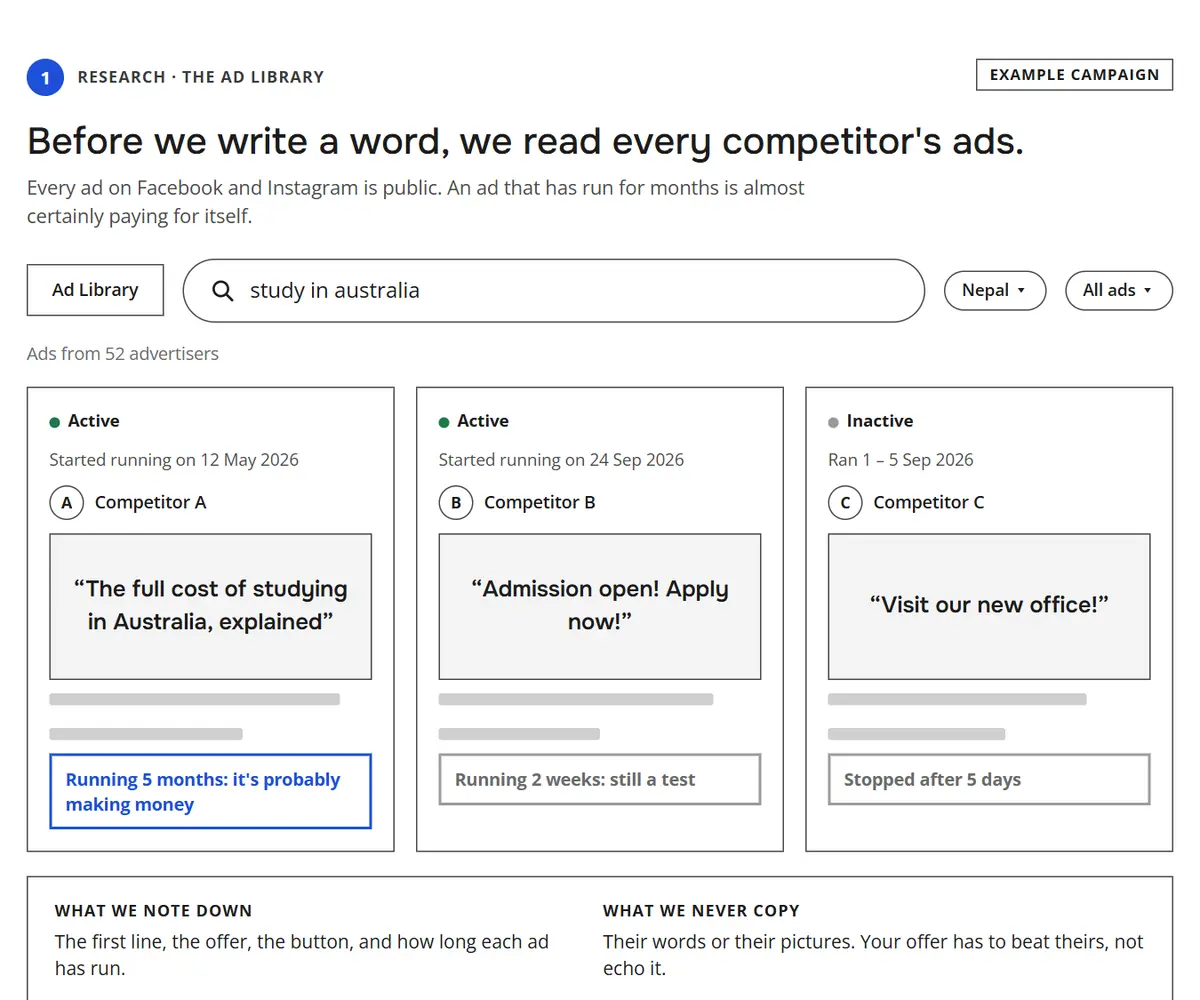
Tell us about your business. Before we call, we look at your offer, your current ads and your competitors’ ads in Meta’s Ad Library, so the first call is useful from minute one.
No dollar card needed: we pay Meta for you in rupees.
Dollar cards have limits. Payments fail at the worst moment and pause your ads. Some businesses borrow a friend’s card, which works until the account gets flagged.
- We pay Meta for your ad spend, so your campaigns don’t stop because a card was declined.
- You pay us in Nepali rupees, with a bill that shows exactly what Meta charged.
- Your ad account stays in your name. You can see every rupee spent, live, in Ads Manager.
- Any fee for handling the payment is agreed in writing before we start.
Facebook ads in Nepal: what our management includes.
Facebook advertising and Meta ads in Nepal (Facebook and Instagram) for businesses in Kathmandu, Lalitpur, Bhaktapur, Pokhara and across Nepal, run from Meta’s Ads Manager.
Offer and strategy
We work out your numbers (what a customer is worth, the most you can spend to win one), build your offer on them with the value equation, add a guarantee, limit or deadline only where your math can carry it, and name it, before we spend a rupee to promote it. A stronger offer is the cheapest way to lower ad costs.
Targeting and retargeting in Nepal
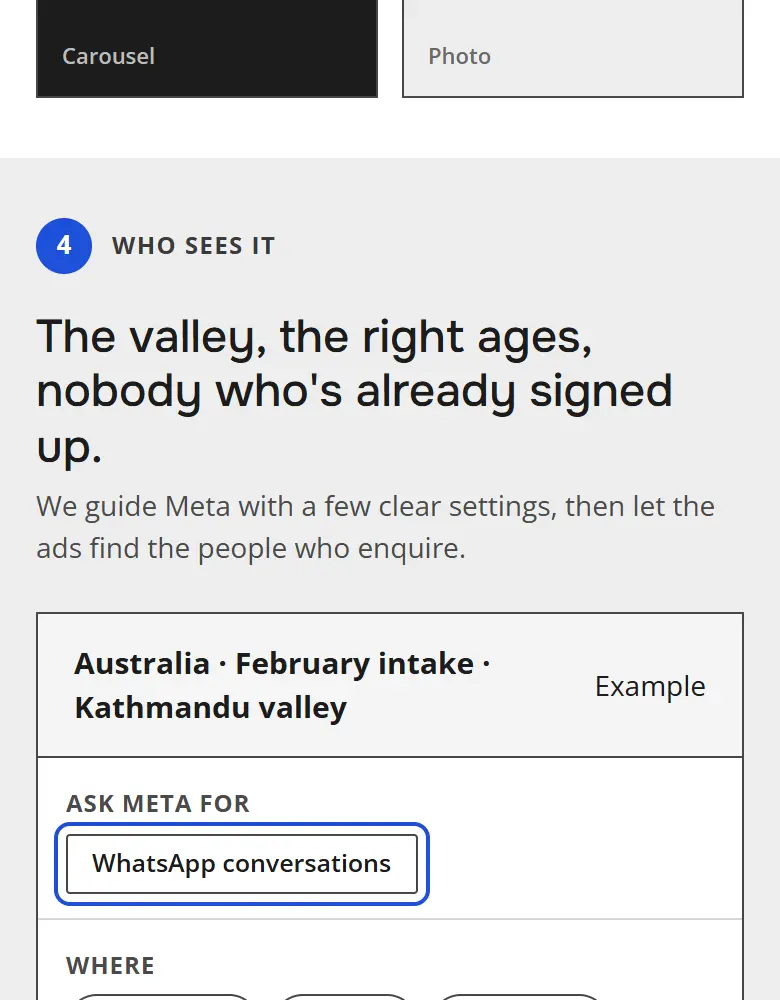
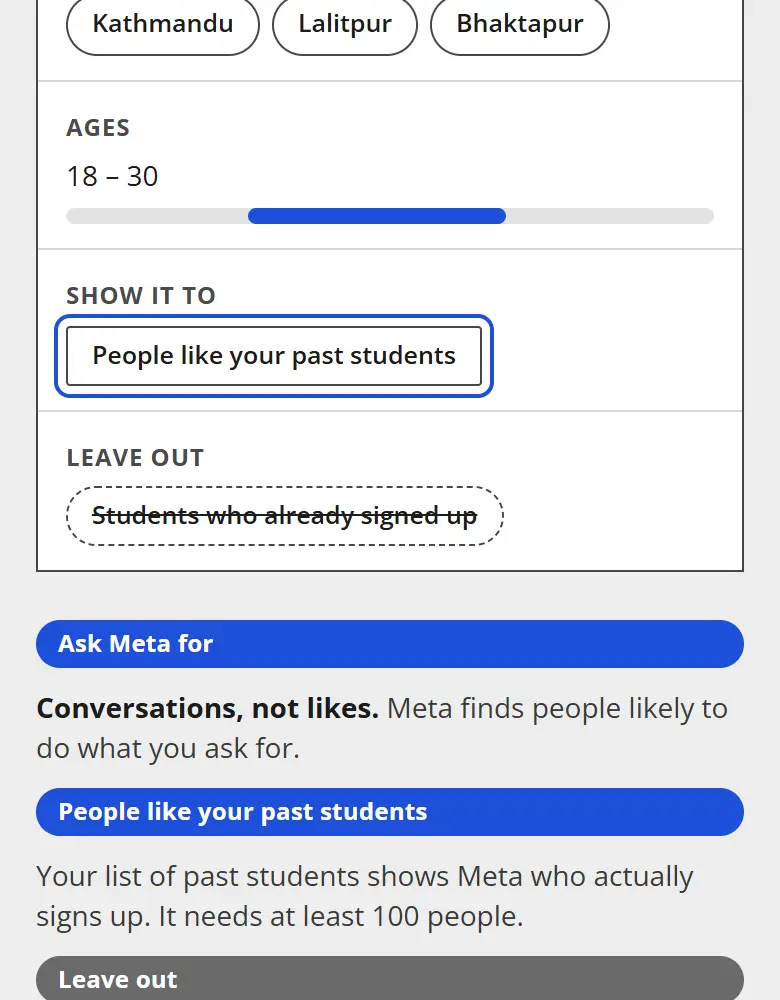
Cities and areas, Meta’s broad audience, lookalikes of your best customers, and retargeting for people who watched, visited or messaged, each shown the next ad in the story.
Ad creatives
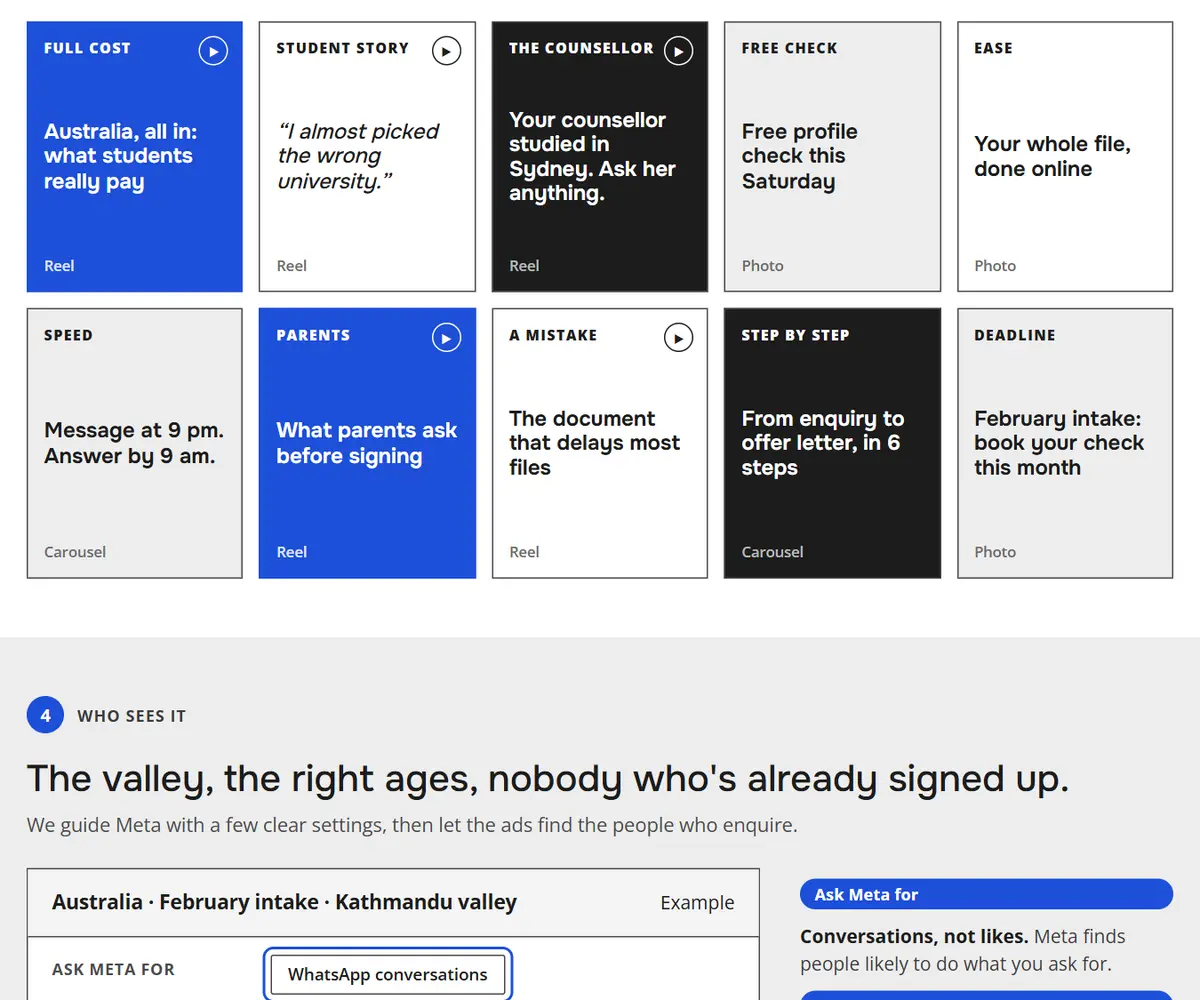
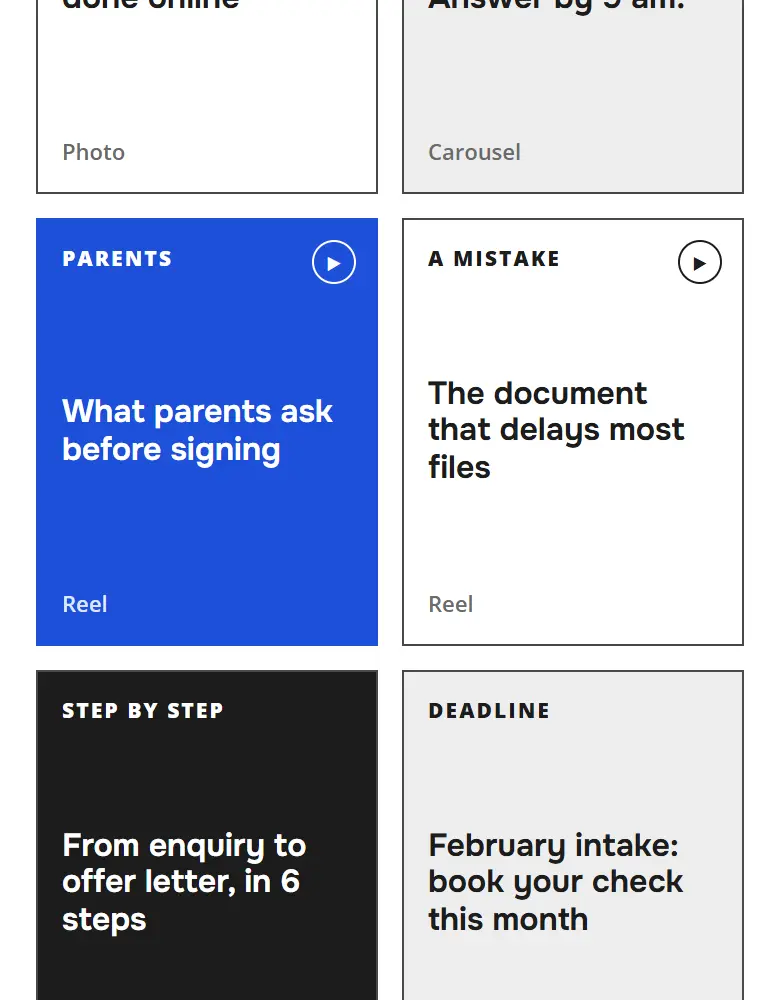
Short videos, images and carousels in English or Nepali, each a different idea: the price, a customer’s story, proof, a deadline. No stock photos.
Campaign setup and tracking
The right objective, the Pixel and Conversions API, click-to-WhatsApp or instant forms, a lead sheet that records which ad brought each customer, and a landing page when you need one.
Testing and scaling
Spending limits set before each test, losers switched off early, budget moved to the winners, and new ideas tested against them every few weeks.
A report in rupees
Spend, enquiries, customers and cost per customer against your 30% line, every month, in plain language, counted from your lead sheet.
Questions people ask before they start.
Straight answers, no sales talk.
How much do Facebook ads cost in Nepal?
There are two costs: the ad spend you pay Meta, and the fee for running the ads. You choose the ad spend. The number that matters is what one customer costs you: on average we aim to keep it under 30% of what that customer pays you. Your real line depends on your margins, your industry and your competitors, and we work it out with you. We give you an exact management fee after the free audit.
Can I run Facebook ads without a dollar card?
Yes. We pay Meta for your ads and you pay us in Nepali rupees, with a bill for every rupee Meta charged. Your ad account stays in your business’s name. Our dollar card guide covers the other ways to pay.
Is boosting a post enough?
For likes and reach, sometimes. For enquiries and sales, usually not. A boosted post gets less control over who sees it and how it is measured. Ads built in Ads Manager can aim for leads, messages or purchases, use your website data, retarget people who showed interest and test several ideas at once.
How much should I spend each month?
Enough to test properly, then whatever keeps a customer under your line. In the test, each new ad may spend up to twice the profit a new customer brings you in their first month, and is switched off if it brings no enquiries by half of that. After that, the budget is worked back from your goal: the customers you want next month × what one costs, plus about 20%, because ads get dearer as they reach more people.
How soon will I get enquiries?
Often within the first days of launch. The first two to four weeks are for testing, so expect the cost per customer to come down after that, not on day one.
Why do you work on our offer before running ads?
Because the offer decides how many people stop, click and buy, and every ad inherits it. We build it from your business math: what a customer is worth to you, and how much risk you can carry. Then a clearer result, proof, a guarantee or a real deadline makes every rupee of ad spend work harder. We only put promises in an ad that your business can keep.
Do I own my ad account?
Yes. Your Business Manager, page, ad account, Pixel and lead sheet stay in your name. We work inside them with the access you give us, and you can remove it at any time.
Can you run Instagram and TikTok ads too?
Instagram ads run from the same Meta Ads Manager as Facebook, so they’re included. TikTok ads are a separate platform; we can advise on them during the audit.
What happens if my ad gets rejected?
We read the rejection reason, fix the ad or the landing page, and request a review if the rejection is a mistake. Most rejections come from a few common policy problems, such as saying what the reader is (“Are you overweight?”), and we write ads to avoid them from the start.
Is Facebook allowed in Nepal?
Yes. Facebook and 25 other platforms were blocked from 4 to 9 September 2025 and then restored. That week is a good reminder not to depend on one platform: your website and Google presence keep working when a social platform goes down.